*Location names and transliterations: location names follow the official language of the current country. If a secondary official or widely used language exists, those names are included in the provenance story section. Established anglicized names are used when available, and all other terms are transliterated per Library of Congress (ALA-LC) standards without diacritics, followed by the Cyrillic in parentheses.
Several vessels were found near the village of Sludka (Слудка) in the Permskii County (Пермский Уезд), of the Perm Governorate (Пермская Губерния) of the Russian Empire in the 18th and 19th century. Sludka is located on the tip of a peninsula jutting into the 12.5 km-wide confluence of the Kama and Obva rivers. The Stroganov family owned this land when the vessels were discovered, and thus, all of them moved through the family’s art collection.
The first hoard, designated as Sludka I, was found in 1750. The hoard includes a single pitcher decorated with dancing women. A plowman from Sludka hit the vessel while tilling a field (Köhler 1853: 42). Alexander S. Stroganov received word of the find on his family’s land in 1753 and requested that the ewer be brought to Paris for study (Marshak 2000: 101, fn. 2). In Paris scientific illustrator Élisabeth Haussard etched the piece for its first publication by Charles de Brosses (de Brosses 1755/1764: 777). The vessel was still with Alexander Stroganov in Paris in 1775, but soon after lost or destroyed with the French Revolution (Smirnov 1909: 14, T XLI № 79).
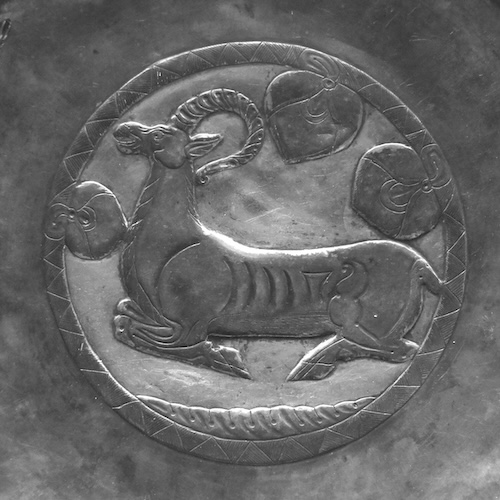
Five more vessels, designated at Sludka II, were found in the sand on the shore of the Kama River. Children playing in 1780 first found a plate decorated with a Greek story (Köhler 1853: 44). Soon thereafter (1780 or 1781) Three more plates– decorated with a hoarse, a goat, and Arabic inscriptions respectively– and a lobed bowl were found (Köhler 1853: 45-48). The Stroganovs purchased all of the vessels from the parents of the children who found them (Marshak 2000: 103). These five vessels were kept with the Stroganov collection in Saint Petersburg until the Stroganov palace was seized during the Revolution. All five vessels were then transferred to the State Hermitage Museum in 1925, where they still reside.
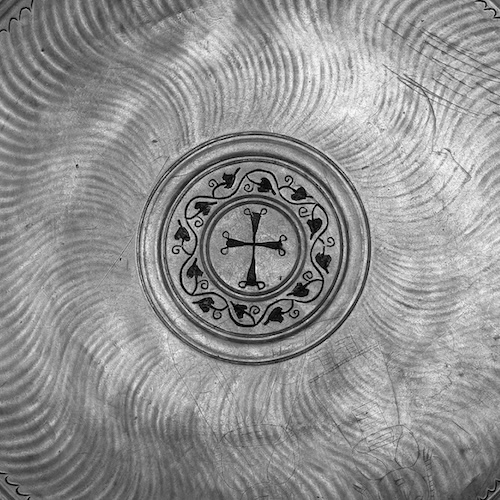
Two more vessels were found around the village of Sludka in the 1870s; these are designated as Sludka III. In 1873 Grigorii S. Stroganov purchased a plate decorated with a woman feeding a snake from a local inhabitant, as well as a plate with a cross sometime in the 1870s. G. S. Stroganov took the plates to Rome where they were housed in his Palazzo Stroganoff. His daughter, Mariia Shcherbatova, then gifted the plates to the Imperial Hermitage Museum after her father’s death. Both plates are still housed in the renamed State Hermitage Museum.
Sludka is presently a village in the Il’inskii District (Ильинский Район), Perm Province/Krai (Пермский Край), Russian Federation.
Darkevich, V. P. Khudozhestvennyi metall Vostoka VIII-XIII vv.: proizvedeniia vostochnoi torevtiki na territorii evropeiskoi chasti SSSR i Zaural’ia. Moscow: Nauka, 1976.
Orbeli, I. A., and K. V. Trever. Sasanidskii metall khudozhestvennye predmenty iz zolota, serebra, i bronzy. Moscow-Leningrad: Akademiia, 1935.
Smirnov, Ia. I. Vostochnoe serebro: atlasʺ drevnei serebrianoi i zolotoi posudy vostochnago proiskhozhdeniia naidennoi preimushchestvenno vʺ prědelakhʺ Rossiiskoi imperii. Saint Petersburg: Publishing House of the Imperial Archaeological Commission, 1909.
Trever, K. V., and V. G. Lukonin. Sasanidskoe serebro: sobranie Gosudarstvennogo Ermitazha: khudozhestvenniia kul’tura Irana III-VIII vekov. Moscow: Iskusstvo, 1987.
de Brosses, Charles (le Président de Brosses). “Description d’un Vase et de quatre manuscrits: nouvellement trouvés en Sibérie.” Histoire de l’Académie royale des inscriptions et belles-lettres, avec les Mémoires de littérature tirés des registres de cette académie des inscriptions et belles-lettres XXX (recorded 1755/published 1764), 777-801.
von Köhler, Heinrich Karl Ernst. “Über die Denkmäler der Altertums aus Silber in der Sammlung des Herrn Grafen von Stroganow.” H. K. E. Köhler’s Gesammelte Schriften, edited by Ludolf Stephani, 41-53. Volume 6. Saint Petersburg: Druckerei der Kaiserlichen Akademie der Wissenschaften, 1853 (reprint from the Göttingische Gelehrte Anzeigen, 1803).
Otchet Imperatorskoi Arkheologicheskoi komissii za 1874 god. Saint Petersburg, 1877.